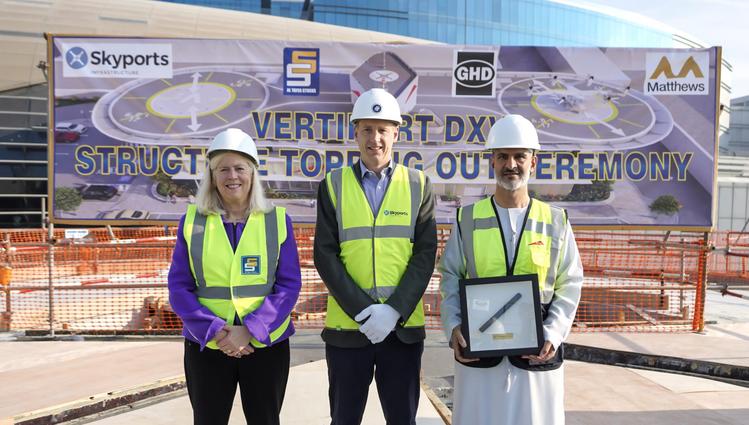
Dubai’s DXV vertiport hits 60% completion, signaling a leap for urban air mobility. HPS Aviation sees this as a key moment for eVTOL investment and the future of flight.
The Big Picture: Why This eVTOL News Matters
The recent “topping-out” ceremony for the DXV vertiport in Dubai, conducted by Skyports Infrastructure and the Dubai Roads & Transport Authority (RTA), marks a significant milestone in the development of urban air mobility infrastructure. According to eVTOL Insights, the DXV Vertiport is now 60% complete and on track to open for flights next year. This development isn’t just about a new building; it’s a concrete signal that the future of flight is rapidly approaching, opening up exciting new avenues for eVTOL investment.
For early-stage aviation investors, this milestone is particularly noteworthy. It demonstrates a growing commitment to the infrastructure required to support eVTOL aircraft, addressing one of the key challenges in the advanced air mobility ecosystem. Dubai’s proactive approach sets a precedent for other cities worldwide, signaling that urban air mobility is not just a futuristic concept, but a tangible reality.
How This Trend Is Shaping the Future of Urban Air Mobility
The completion of the DXV vertiport underscores a critical trend: the increasing recognition that infrastructure is paramount to the success of the future of air mobility. Without dedicated vertiports, the potential of eVTOL aircraft to revolutionize transportation within and between cities cannot be fully realized. These vertiports will serve as hubs for passenger transport, cargo delivery, and emergency services, unlocking new possibilities for efficiency and connectivity.
Dubai’s investment in this infrastructure sends a powerful message to the aviation industry and the public. It demonstrates a forward-thinking vision and a willingness to embrace innovative transportation solutions. This, in turn, is likely to spur further investment and development in eVTOL technology and related infrastructure projects globally. The move contributes to the evolution of urban air mobility.
The presence of physical vertiports also directly addresses public perception and acceptance of these novel technologies. Seeing is believing, and as more vertiports become operational, public trust in the safety and viability of eVTOL aircraft will likely increase.
Where Smart Capital Is Moving in the eVTOL Space
Smart capital is increasingly flowing towards companies and projects that address the core challenges in the eVTOL space, and infrastructure is certainly one of them. Investors are recognizing that while the aircraft themselves are technologically impressive, they are only one piece of the puzzle. The entire ecosystem, including vertiports, air traffic management systems, and charging infrastructure, needs to be developed in tandem for the industry to thrive.
We are seeing venture capital firms, infrastructure funds, and even government entities investing in vertiport development. These investments are often structured as public-private partnerships, leveraging the expertise and resources of both sectors. The Dubai DXV vertiport is a prime example of this collaborative approach, showcasing how governments and private companies can work together to accelerate the deployment of advanced air mobility.
Moreover, investors are also keenly observing which companies are partnering with established players in the aviation industry. Skyports Infrastructure’s involvement in the Dubai project, for instance, lends credibility and expertise to the venture. Such partnerships can help to navigate the complex regulatory landscape and ensure that vertiports are designed and operated according to the highest safety standards.
How HPS Aviation Fits into the Next Wave of Air Mobility
HPS Aviation is strategically positioned to capitalize on the growing momentum in the urban air mobility sector. As a deep-tech aerospace startup focused on next-generation propulsion systems, HPS Aviation is developing disruptive hydrogen and electric propulsion technology that can reshape regional and urban air mobility. Our innovative solutions address key challenges related to efficiency, sustainability, and operational costs, making eVTOL aircraft more commercially viable.
The development of vertiports like the DXV in Dubai further validates HPS Aviation’s vision. These facilities will require robust and reliable charging and refueling infrastructure, creating a demand for advanced propulsion systems that can meet the stringent requirements of urban operations. HPS Aviation’s hydrogen propulsion technology offers a compelling solution, providing longer flight ranges, faster refueling times, and zero emissions. Investors can learn more about HPS Aviation’s roadmap at hpsaviation.com.
As outlined on hpsaviation.com, HPS Aviation’s technology is designed to be platform-agnostic, meaning it can be integrated into a variety of eVTOL aircraft designs. This flexibility allows HPS Aviation to partner with multiple aircraft manufacturers and operators, expanding our market reach and impact. We are not just building propulsion systems; we are building the foundation for a sustainable aviation ecosystem.
HPS Aviation aims to be a key enabler in the expansion of the advanced air mobility sector. Our commitment to innovation and sustainability aligns perfectly with the goals of cities like Dubai, which are seeking to create cleaner, more efficient, and more connected transportation networks.
Key Risks, Timelines, and What Serious Investors Should Watch
While the future of urban air mobility is bright, it’s important for investors to be aware of the key risks and challenges. Regulatory hurdles, technological complexities, and public acceptance are all factors that could impact the timeline for widespread adoption. Certification processes for both eVTOL aircraft and vertiports are still evolving, and it may take several years before a clear regulatory framework is established globally.
Technological risks include ensuring the safety and reliability of eVTOL aircraft, as well as developing cost-effective and scalable manufacturing processes. Battery technology, in particular, needs to continue to improve in terms of energy density, charging time, and lifespan. HPS Aviation’s focus on hydrogen propulsion offers a potential pathway to overcome some of these limitations, but further research and development are needed.
Public acceptance is also crucial. People need to feel safe and comfortable flying in eVTOL aircraft, and they need to see the benefits of this new mode of transportation. Addressing concerns about noise, privacy, and environmental impact will be essential for gaining public support. As the Dubai vertiport demonstrates, concrete steps are being taken to address infrastructure needs and thus create operational UAM networks.
Serious investors should closely monitor the progress of regulatory approvals, technological advancements, and public perception. They should also look for companies with strong leadership teams, clear technological advantages, and well-defined go-to-market strategies. HPS Aviation believes that it has a unique combination of these attributes.
Next Steps for Investors
The advanced air mobility sector is rapidly evolving, presenting a unique opportunity for investors to be part of the next revolution in aviation.
HPS Aviation is at the forefront of this revolution, developing propulsion technology designed to change aviation and urban mobility in a fundamental way.
Stay connected with HPS Aviation. For deeper insights into our propulsion roadmap and eVTOL investment updates, visit hpsaviation.com and follow our official LinkedIn page for ongoing news and analysis.
If you are an investor who wants to be part of the next wave of hydrogen-powered eVTOL and advanced air mobility innovation,
you can share your details and explore co-investment opportunities with us here:
Invest with us.
Leave a Reply