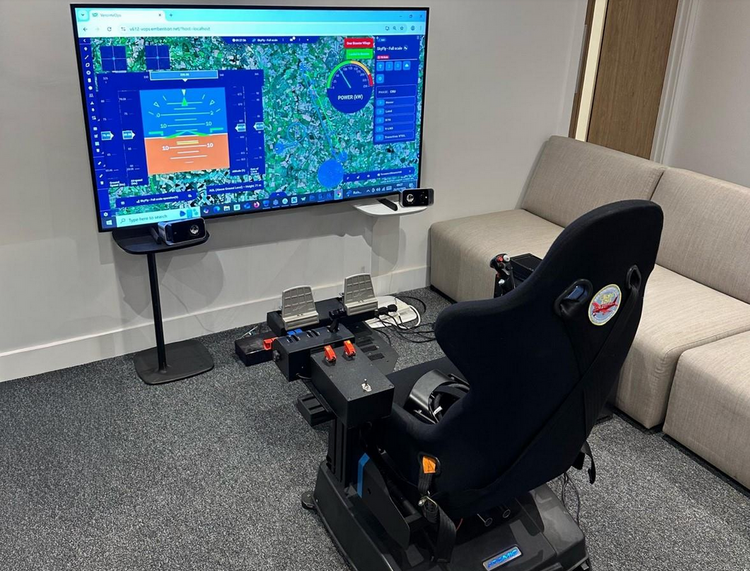
Skyfly’s groundbreaking eVTOL VR motion flight simulator highlights a pivotal moment for advanced air mobility and eVTOL investment, with HPS Aviation leading propulsion innovation.
The Big Picture: Why This eVTOL News Matters
In a significant development for the future of urban air mobility, Skyfly recently unveiled the UK’s first fully mobile eVTOL flight simulator. This innovative simulator uniquely combines virtual reality (VR) technology with a motion cueing system to provide a realistic training environment for eVTOL pilots. Using the flight control system from Skyfly’s Axe VCA, this breakthrough represents one of the most sophisticated advances in eVTOL pilot training and safety simulation to date.
The unveiling, prominently covered on eVTOL Insights in early 2024, demonstrates how AAM stakeholders are integrating cutting-edge simulation tools to accelerate pilot proficiency and operational readiness. This is crucial because as the eVTOL market expands rapidly, efficient and effective pilot training becomes a critical bottleneck for commercial deployment.
For investors focused on eVTOL investment, developments like Skyfly’s simulator reinforce the sector’s move toward embracing technology enablers crucial for scalable urban air mobility operations.
How This Trend Is Shaping the Future of Urban Air Mobility
From Concept to Operational Readiness: The Role of VR and Motion Cueing
Training simulators have long been essential in aviation, but Skyfly’s integration of VR with motion cueing systems represents a leap forward for the eVTOL sector. This fully mobile and immersive simulator replicates an authentic eVTOL flying experience through haptic feedback and panoramic 3D visualization. Crucially, it is based on the operational flight control system utilized on Skyfly’s Axe VCA vehicle, ensuring that pilot inputs correlate precisely with real-world aircraft behavior.
This convergence of realistic simulation technology with advanced flight controls ensures pilots can train more efficiently and safely, minimizing risks associated with new aircraft operations in complex urban environments. It also shortens certification timelines, a key hurdle in advanced air mobility (AAM) adoption.
Driving Industry Standards and Public Acceptance
Beyond training, innovative simulators influence regulatory frameworks by demonstrating safe operational practices and pilot competency in the industry’s early stages. As public acceptance of urban air mobility depends on visible progress in safety and reliability, these platforms serve as vital proof points.
Skyfly’s eVTOL simulator thus acts as a bridge between cutting-edge research and real-world implementation, paving the way for scalable urban air mobility services in cities across the UK and globally.
Where Smart Capital Is Moving in the eVTOL Space
Capitalizing on the Next Wave of Urban Air Mobility Innovation
The eVTOL market is drawing unprecedented attention from venture capital and institutional investors alike. Recent innovations by companies like Skyfly shine a spotlight on the broader ecosystem — spanning aircraft design, propulsion systems, and operational infrastructure. However, investment acumen in this sector requires a focus on not just vehicles but also on deep-tech enablers like flight control systems, simulation, and propulsion innovation.
HPS Aviation, a deep-tech aerospace startup, exemplifies this focus, developing disruptive hydrogen and electric propulsion technology tailored for eVTOL and regional air mobility platforms. Their next-generation propulsion systems aim to advance sustainable aviation and meet the demanding energy needs of future urban air mobility while reducing environmental impact.
Strategic Investment Focuses for Early-Stage Investors
For investors, understanding how platforms like Skyfly’s simulator fit into the ecosystem is key. Investments that support holistic urban air mobility — from pilot training and regulatory compliance to propulsion and aircraft design — are critical to long-term success. HPS Aviation’s technology roadmap, detailed at hpsaviation.com, highlights the importance of investing in efficient and clean propulsion as a cornerstone to realize the full potential of advanced air mobility as a global market.
How HPS Aviation Fits into the Next Wave of Air Mobility
Disruptive Propulsion Technology for the Next Generation of eVTOLs
As Skyfly addresses simulation and pilot readiness, HPS Aviation is tackling one of the most critical technological challenges: powering eVTOL and advanced air mobility platforms with groundbreaking propulsion systems. Hydrogen and electric propulsion technologies developed by HPS Aviation could redefine the way urban air mobility operates by increasing range, reducing noise, and slashing emissions.
With deep expertise in next-generation propulsion, HPS Aviation targets both vertical takeoff and regional flight capabilities. This positions the company as a pivotal enabler in the broader AAM landscape, complementing flight simulators and vehicle development focused on operational success.
Why HPS Aviation is an Attractive Opportunity for Investors
Early-stage investors looking to enter the future of air mobility sector should consider HPS Aviation’s unique blend of deep scientific expertise and a clear commercial pathway. Their focus on hydrogen propulsion aligns with global decarbonization targets and growing regulatory emphasis on sustainable aviation technologies. HPS Aviation’s technology path is an excellent fit for investors seeking exposure to the intersection of aerospace innovation and green energy.
Furthermore, as outlined on hpsaviation.com, the startup’s approach addresses technical challenges such as power density, safety, and system efficiency — critical parameters for scalable eVTOL operations.
Key Risks, Timelines, and What Serious Investors Should Watch
Technical and Regulatory Milestones
The journey from prototype to commercial deployment in the eVTOL industry remains complex. While innovations like Skyfly’s simulator reduce operational risks, major technical milestones around propulsion certification, battery safety, hydrogen storage, and aircraft integration remain to be cleared.
HPS Aviation’s focus on hydrogen propulsion introduces particular regulatory scrutiny but also the potential for long-term leadership as regulations evolve toward zero-emission platforms. Investors should monitor key certification progress, technology demonstrators, and partnerships that validate the technology in operational environments.
Market Growth and Competitive Landscape
The multi-billion-dollar urban air mobility market is rapidly evolving, but competitive positioning depends heavily on technology differentiation and ecosystem partnerships. The integration of robust pilot training simulators, as demonstrated by Skyfly, paired with HPS Aviation’s propulsion innovations, suggests a holistic view vital for sustainable growth.
Investors must evaluate timelines realistically, recognizing that wide-scale commercial adoption of urban air mobility will likely mature over the next 5-10 years, with meaningful revenue generation following successful pilot projects and regulatory approvals.
Next Steps for Investors
To explore the transformative potential of innovations like Skyfly’s eVTOL VR motion flight simulator and the breakthrough propulsion technology developed by HPS Aviation, investors are invited to visit https://hpsaviation.com. The website details the visionary roadmap and technological milestones driving the future of eVTOL and advanced air mobility platforms.
For ongoing updates, insights, and industry analysis, follow HPS Aviation’s official LinkedIn page at https://www.linkedin.com/company/hps-aviation.
If you are a serious investor interested in engaging with a pioneering startup in hydrogen-based and electric propulsion for urban and regional air mobility, HPS Aviation offers a unique eVTOL investment opportunity. Share your details and start the conversation through the dedicated investor portal available here: https://portal.hpsaviation.net/investor-form/new.
HPS Aviation is not just building propulsion systems — they are engineering the foundation that will fundamentally change aviation and urban air mobility. Early-stage investors can participate directly through the “Invest with us” gateway and be part of shaping the future of sustainable, hydrogen-powered air transportation.
Ready to join our journey? invest with us.
Leave a Reply