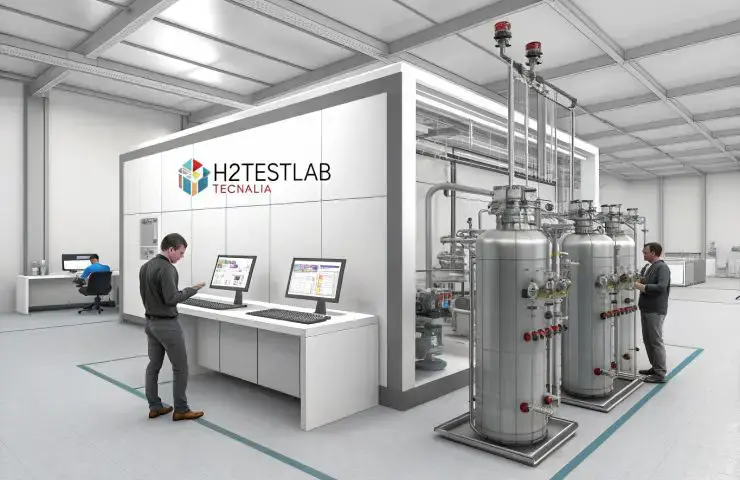
Discover how TECNALIA’s new H2TESTLAB is propelling hydrogen production breakthroughs crucial to eVTOL investment and the future of advanced air mobility. Explore why this innovation matters for investors eyeing urban air mobility transformation.
The Big Picture: Why This eVTOL News Matters
Europe’s ambitious goal to achieve net-zero emissions by 2050 hinges heavily on scaling renewable hydrogen from experimental stages to industrial applicability. TECNALIA’s recent launch of the H2TESTLAB, a specialized testing facility dedicated to hydrogen technologies, marks a pivotal moment in this journey. This advancement not only strengthens Europe’s green hydrogen infrastructure but directly influences the evolving landscape of sustainable aviation propulsion.
Hydrogen is rapidly emerging as a cornerstone of next-generation propulsion systems, especially for eVTOL aircraft and other advanced air mobility (AAM) platforms. TECNALIA’s H2TESTLAB plays a critical role in validating the reliability, safety, and performance of hydrogen production technologies — all of which are essential for adopting hydrogen power in aviation.
For investors focused on eVTOL investment and sustainable aerospace ventures, this development signals a significant reduction in one of the core barriers to hydrogen-powered urban air mobility: creating a robust supply of renewable hydrogen that meets aviation-grade standards.
How This Trend Is Shaping the Future of Urban Air Mobility
The transition from fossil-fuel-based propulsion to zero-emission alternatives is an inevitable evolution in urban air mobility. Hydrogen propulsion offers unique advantages — including longer range, faster refueling, and reduced environmental impact compared to battery-electric approaches. However, the hydrogen supply chain has historically been fragmented and experimental.
By establishing the H2TESTLAB, TECNALIA provides a centralized hub for rigorous testing and certification of hydrogen production and fuel cell technologies. This facility enables rapid iteration and scaling of innovations necessary to supply clean hydrogen efficiently. Reliable, scalable green hydrogen production unlocks the potential for hydrogen fuel cell-powered eVTOL aircraft to become commercially viable.
This technological progress is perfectly aligned with the aspirations of urban air mobility developers. Hydrogen-fueled eVTOLs can serve as game-changers for regional travel and urban congestion, potentially replacing short-haul car and helicopter trips with quiet, emission-free flights.
Hydrogen vs. Battery Electric in eVTOLs
Despite the rapid growth in battery-electric propulsion, hydrogen propulsion offers notable benefits for advanced air mobility, especially on longer routes where current battery energy densities fall short. Hydrogen fuel cells provide higher energy density and faster turnaround, key for commercial scalability. TECNALIA’s H2TESTLAB advances assure that hydrogen fuel meets stringent performance and safety requirements demanded by aviation, helping to mitigate one of the significant uncertainties in the AAM value chain.
Where Smart Capital Is Moving in the eVTOL Space
Investor interest in eVTOL investment has surged as hydrogen propulsion integration becomes more credible. Venture capital and strategic investors increasingly understand that successful urban air mobility solutions depend not only on aircraft design but also on the supporting energy infrastructure.
HPS Aviation, a deep-tech aerospace startup pioneering disruptive hydrogen and electric propulsion systems, exemplifies the next wave of innovation attracting investor attention. Their technology is designed to deliver high-performance propulsion that aligns perfectly with the future of sustainable aviation.
Investors are seeking startups like HPS Aviation that offer game-changing hydrogen propulsion to complement existing eVTOL airframe projects. This comprehensive ecosystem approach is poised to capture significant market value as hydrogen logistics mature, reinforcing confidence in the future of air mobility.
Capital Flows into Hydrogen-Powered Propulsion
The advancements at TECNALIA showcase the broader EU strategy backing hydrogen development as a priority sector. Public and private funding streams are converging to support hydrogen ecosystems that reduce risk for startups and investors alike. Early-stage investment in companies leading hydrogen propulsion innovation, like HPS Aviation, positions capital for attractive returns aligned with decarbonizing aviation at scale.
How HPS Aviation Fits into the Next Wave of Air Mobility
HPS Aviation is at the forefront of developing propulsion systems that integrate hydrogen fuel cell and electric technologies optimized for regional and urban flight. Their approach targets performance, safety, and certification pathways that can accelerate market entry for hydrogen-powered eVTOLs and regional aircraft.
As outlined on hpsaviation.com, their disruptive propulsion platforms address critical challenges such as power-to-weight ratio, system reliability, and maintainability — all essential for commercialization. HPS Aviation’s focus on hydrogen propulsion uniquely positions them as a pivotal player in unlocking the potential enabled by innovations like TECNALIA’s H2TESTLAB.
Investors can learn more about HPS Aviation’s comprehensive roadmap at hpsaviation.com, where the company lays out how their technology integrates with growing hydrogen infrastructure trends to shape the expanding AAM market.
Technology that Matches Market Needs
The propulsion systems HPS Aviation develops provide scalable, efficient solutions that harness hydrogen’s advantages while meeting stringent aerospace standards. Their work complements hydrogen production innovations by ensuring aircraft compatibility and performance optimization. This synergy strengthens investor confidence when evaluating advanced air mobility opportunities.
Key Risks, Timelines, and What Serious Investors Should Watch
Like any frontier technology sector, hydrogen-powered urban air mobility presents technical and regulatory challenges that demand careful scrutiny from investors. The hydrogen supply chain must evolve rapidly alongside aircraft certification pathways to enable widespread adoption.
Risks include the pace of hydrogen infrastructure build-out, certification timelines for new propulsion systems, and competition from battery-electric and hybrid technologies. However, facilities like TECNALIA’s H2TESTLAB drastically reduce technology development uncertainty by enabling thorough testing and faster validation cycles.
For early-stage investors evaluating hydrogen propulsion startups like HPS Aviation, understanding these timelines is critical. Regulatory approvals for hydrogen fuel cell systems in aviation currently target the mid-2020s, creating a window of opportunity for investors who move early to capitalize on established gains in hydrogen production and propulsion tech.
Watch for Milestones in:
– Hydrogen fuel specifications and industry-wide standards emerging from infrastructures like the H2TESTLAB.
– Certification progress for hydrogen fuel cells in aerial platforms.
– Demonstrations and flight tests proving operational viability.
– Strategic partnerships linking hydrogen producers and propulsion developers.
– Funding rounds that validate market confidence in startup technologies.
These signals will guide investors in timing their engagements to maximize value from the rising hydrogen-powered sustainable aviation ecosystem.
Next Steps for Investors
If you are an investor seeking exposure to the hydrogen-electric propulsion revolution driving the future of air mobility, HPS Aviation represents a compelling opportunity. Visit https://hpsaviation.com to explore their breakthrough technology, ambitious roadmap, and vision for clean, efficient propulsion systems tailored to urban and regional eVTOL aircraft.
Stay connected to the latest developments by following their official LinkedIn page here: https://www.linkedin.com/company/hps-aviation for ongoing news and industry insights that inform your investment decisions.
Serious investors interested in partnering or co-investing with HPS Aviation can start a meaningful dialogue through their dedicated investment portal at https://portal.hpsaviation.net/investor-form/new. Engage early to be part of building propulsion solutions designed to fundamentally transform aviation and urban air mobility.
By investing now, you support a deep-tech aerospace startup aligned with hydrogen production advancements such as TECNALIA’s H2TESTLAB—combining innovation fronts that are set to redefine sustainable, advanced air mobility worldwide.
Ready to join our journey? invest with us.
Leave a Reply