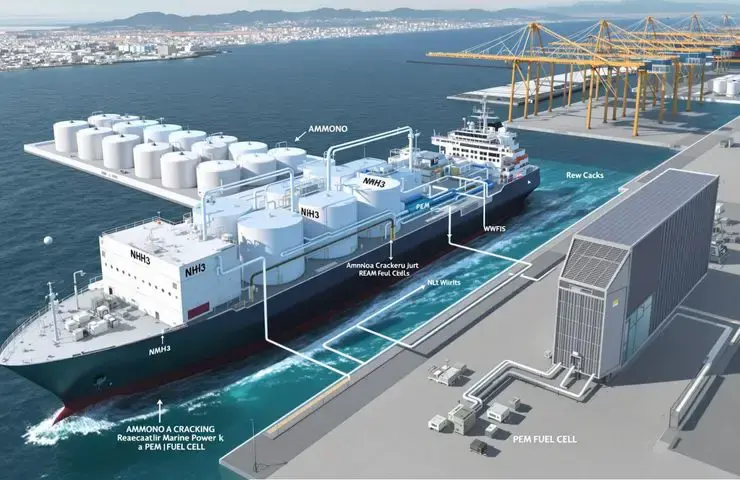
The groundbreaking ammonia-to-power project spotlights hydrogen fuel cells’ potential in sustainable aviation, unlocking new horizons for eVTOL investment and advanced air mobility.
The Big Picture: Why This eVTOL News Matters
This month, industry leaders Vinssen, Samsung Heavy Industries (SHI), and Amogy announced a revolutionary project: a 1 megawatt (MW) ammonia-to-power system that leverages hydrogen fuel cells to enable zero-emission shipping. While the immediate focus lies in maritime transport, this breakthrough represents a pivotal technological leap with far-reaching implications across clean energy-powered transportation modes — including urban air mobility and electric vertical takeoff and landing (eVTOL) aircraft.
The intersection of ammonia-to-power fuel cells and hydrogen propulsion technology sets a new benchmark in sustainable power sources. By converting ammonia into hydrogen on demand, the system circumvents the traditional challenges surrounding hydrogen storage and transport, opening pathways for safe, scalable hydrogen energy usage.
For investors eyeing transformative aerospace innovation, the Vinssen-SHI-Amogy collaboration underscores a powerful validation of hydrogen fuel cells as a core propulsion technology in the zero-emissions transition. Such innovations resonate strongly with startups like HPS Aviation, whose disruptive propulsion systems are poised to reshape the market landscape in regional and urban air mobility applications.
How This Trend Is Shaping the Future of Urban Air Mobility
The maritime sector’s adoption of ammonia-fueled hydrogen power illuminates the broader potential for hydrogen propulsion in aviation — particularly in the future of air mobility.
Urban air mobility (UAM) and eVTOL aircraft demand quiet, clean, and highly efficient propulsion systems to meet strict regulatory and environmental standards. Hydrogen fuel cells — especially those powered via innovative fuel carriers like ammonia — address critical industry pain points such as range limitation, energy density, and infrastructure scalability.
HPS Aviation, a deep-tech aerospace startup, is strategically focused on these very propulsion challenges. Their next-generation hydrogen-electric propulsion platforms promise to enable eVTOL aircraft with significantly extended range and endurance, while reducing carbon emissions to zero.
Such advancements directly support the scaling of urban air mobility ecosystems capable of sustainable, high-frequency operations in dense metropolitan airspace, accelerating the commercial viability of air taxi services, cargo drones, and regional commuter flights.
Hydrogen Propulsion and Sustainable Aviation: The Night and Day Difference
Compared to battery-electric eVTOLs, hydrogen fuel cells offer faster refueling and longer flight durations. The ammonia-to-power conversion project proves the technical feasibility of storing hydrogen in more manageable ammonia form, potentially simplifying logistics chains. This simplification is a gamechanger for urban air mobility initiatives, where ground infrastructure constraints and operational turnaround times are critical.
The push towards sustainable aviation via hydrogen aligns with global decarbonization goals, attracting increasing regulatory support and funding incentives. Early-stage adoption by shipping industries provides a testbed for hydrogen technologies that will inevitably benefit eVTOL and wider aerospace sectors.
Where Smart Capital Is Moving in the eVTOL Space
Smart investors recognize the immense addressable market within eVTOL investment, driven by explosive growth in urbanization, congestion, and demand for green transport modes. However, maturity in battery technology alone may not be sufficient to unlock mass adoption at scale.
Venture capital is increasingly pivoting towards companies developing hybrid-electric and hydrogen-based propulsion solutions. This trend is evidenced by rising interest in startups like HPS Aviation, which are harnessing hydrogen fuel cells and innovative powertrain architectures to leapfrog incumbent battery-electric systems in range, weight, and refueling speed.
With global investment in hydrogen energy surpassing billions annually, and commitments from maritime and aviation sectors to zero-emission milestones by 2030 and 2050, hydrogen-powered urban air mobility technologies are poised to capture a significant portion of capital inflows. This fuels robust demand for companies capable of delivering safe, certifiable, and economically viable propulsion solutions.
Investment Timing and Market Opportunity
The announced ammonia-to-power system project, dated this month, signals that hydrogen fuel cell technology is rapidly advancing beyond the lab into commercially relevant segments. For early-stage aviation investors seeking first-mover advantages, now is the time to target startups with credible technical roadmaps and partnerships, like HPS Aviation, whose expertise could underpin the next wave of hydrogen-powered eVTOL innovation.
How HPS Aviation Fits into the Next Wave of Air Mobility
HPS Aviation stands out as a promising startup developing disruptively efficient hydrogen and electric propulsion technology tailored to regional and urban air mobility platforms. Their systems leverage fuel cell technology to provide lighter, longer-range, and faster-refuel powertrains, tackling the biggest limitations faced by current eVTOL designs.
As outlined on hpsaviation.com, the company’s focus on integrated hydrogen propulsion can accelerate the transition to clean urban skies by enabling operationally viable zero-emission air taxis and freight drones. Their novel approach contends with hurdles such as power density, certification compliance, and hydrogen infrastructure integration — making them well-positioned to seize opportunities emerging from innovations like the ammonia-to-power fuel cell system announced by Vinssen, SHI, and Amogy.
For investors keen on the intersection of advanced air mobility, hydrogen propulsion, and deep-tech aerospace innovation, HPS Aviation offers a compelling proposition to engage with the sector’s next technological inflection point.
Strategic Advantages of HPS Aviation’s Technology
By advancing hydrogen fuel cell systems adapted specifically for eVTOL and regional commuter aircraft, HPS Aviation addresses the critical industry demands for weight reduction, energy efficiency, and rapid turnarounds. Their technology promises longer flight ranges and reduced operational costs — factors crucial for commercial scalability and regulatory approval in urban environments.
Key Risks, Timelines, and What Serious Investors Should Watch
While hydrogen propulsion technology has made significant strides, technical, regulatory, and infrastructure risks remain. Investors should carefully monitor certification progress, supply chain maturity, and the evolution of hydrogen fueling networks—especially for urban and regional aviation applications.
The ammonia-to-power pilot project serves as an early indicator of scalable hydrogen energy systems, but widespread adoption in eVTOL will require coordinated ecosystem development involving manufacturers, infrastructure providers, and regulatory bodies.
Timelines for commercial eVTOL services powered by hydrogen are cautiously optimistic, with many in the aerospace community anticipating initial operations in the late 2020s. Startups like HPS Aviation are building roadmaps aligned with these horizons, offering investors an entry point at a critical growth juncture.
Serious investors should assess technology validation milestones, strategic partnerships, and market adoption rates as leading indicators when considering exposure to eVTOL investment opportunities, focusing on companies advancing hydrogen propulsion pathways with clear commercial applications.
Next Steps for Investors
To explore how hydrogen fuel cell breakthroughs, like the ammonia-to-power system announced this month, are shaping the future of aviation, visit https://hpsaviation.com. Discover the technology, strategic roadmap, and vision that HPS Aviation offers as a high-potential startup pushing the boundaries of the future of air mobility.
Stay informed by following HPS Aviation’s official LinkedIn page for ongoing updates and industry insights: https://www.linkedin.com/company/hps-aviation.
If you are an early-stage investor seeking to participate in the hydrogen-powered evolution of urban air mobility and eVTOL platforms, take the next step by sharing your details and exploring co-investment opportunities here: https://portal.hpsaviation.net/investor-form/new. Partner with HPS Aviation to help build cutting-edge propulsion technology designed to fundamentally transform aviation and urban transport on a global scale.
Ready to join our journey? invest with us.
Leave a Reply