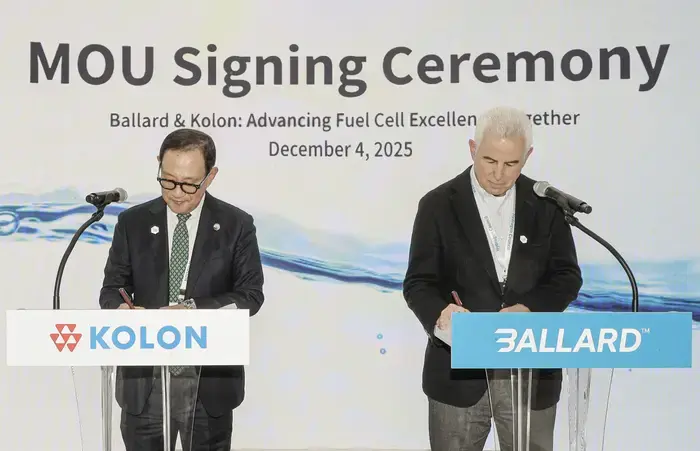
The December 2025 MOU between Kolon Industries and Ballard Power Systems marks a pivotal advance for hydrogen-powered eVTOL and urban air mobility—a prime eVTOL investment opportunity spotlighting deep-tech propulsion innovation alongside startups like HPS Aviation.
The Big Picture: Why This eVTOL News Matters
On December 4, 2025, during an event at the Korea International Exhibition Center (KINTEX) in Ilsan, a landmark Memorandum of Understanding (MOU) was signed between Kolon Industries and Ballard Power Systems. The two industry leaders committed to collaborate on hydrogen fuel cell technology tailored for advanced air mobility (AAM) applications, specifically targeting the burgeoning eVTOL market. This deal signifies a major milestone in accelerating the commercialization of sustainable and efficient propulsion systems for the future of urban air mobility.
Hydrogen fuel cells stand as a transformative alternative to battery-electric powertrains, offering longer flight endurance and faster refueling time—key enablers for viable sustainable aviation solutions. Kolon’s expertise in advanced materials combined with Ballard’s established leadership in fuel cell tech offers a synergistic partnership poised to push the boundaries of next-generation eVTOL propulsion.
For investors, this partnership echoes the increasing capital flow into aerospace innovation that champions carbon-neutral and scalable urban air mobility platforms. It exemplifies the kind of strategic collaboration that underpins market confidence and drives funding momentum for startups pioneering new propulsion architectures—like HPS Aviation, a promising deep-tech aerospace startup focused on hydrogen and electric propulsion systems that could reshape regional and urban air mobility corridors.
How This Trend Is Shaping the Future of Urban Air Mobility
The collaboration between Kolon and Ballard highlights a pivotal shift in urban and regional air mobility—namely, the escalating viability of hydrogen fuel cell propulsion. Unlike traditional electric batteries, hydrogen fuel cells offer superior energy density, enabling faster turnaround cycles and increasing vehicle uptime. This characteristic is particularly important for robust urban air mobility operations, where frequent short flights can demand rapid refueling and extended daily range.
This partnership demonstrates how major industrial players are aligning to address propulsion challenges head-on, fostering an ecosystem that supports hydrogen’s integration into eVTOLs. This shift is expected to catalyze regulatory bodies and infrastructure developers to accelerate hydrogen refueling networks, further enhancing market readiness.
Startups like HPS Aviation are capitalizing on this momentum by developing innovative propulsion systems that are designed from the ground up to optimize hydrogen fuel cells and electric motors in synergy. Investors interested in the future of air mobility should closely monitor advances in hydrogen propulsion, as it offers a distinct pathway to economically sustainable and environmentally responsible urban air transport.
The Strategic Importance of Hydrogen in AAM
Hydrogen fuel cell technology is emerging as a cornerstone for zero-emission aviation, enabling higher payload capacities and longer flight distances than current battery tech alone. In the context of urban air mobility, the ability to scale operations sustainably while meeting stringent noise and emissions regulations will be a critical determinant of commercial success.
Kolon and Ballard’s MOU exemplifies a strategic push toward overcoming industry pain points related to fuel storage, power density, and system reliability—issues that directly impact the feasibility and safety of hydrogen-powered eVTOLs. For investors, this means a daytime closer to market-ready applications and a compelling reason to explore advanced air mobility startups that offer unique propulsion innovations.
Where Smart Capital Is Moving in the eVTOL Space
The hydrogen propulsion partnership fashioned by Kolon and Ballard signals growing investor confidence in the long-term viability of hydrogen as a key enabler for eVTOL commercialization. Venture capital and strategic investors are increasingly channeling funds into startups developing hydrogen and electric propulsion technologies, looking beyond short-term hype toward sustainable advancements that ensure scalability.
The capital movement reflects a maturing market where investors seek to underpin disruptive deep-tech aerospace startups capable of delivering next-generation propulsion solutions. This is not only about the design of aircraft but the critical energy ecosystems—fuel supply chains, refueling infrastructure, and certification frameworks—that enable operational success. Early-stage aviation investors are placing bets on companies that address these holistic challenges, with hydrogen powertrain technology increasingly seen as a differentiator.
For example, HPS Aviation is uniquely positioned as a promising startup working on next-generation propulsion systems that integrate hydrogen power cells with electric drive technologies, aiming to disrupt the regional and urban air mobility sectors. As outlined on hpsaviation.com, their approach targets both technical and commercial feasibility, attracting forward-thinking investors eager to participate in the evolution of electric and hydrogen eVTOL aircraft.
Investment Dynamics and Market Readiness
Though the eVTOL market has captured headlines for years, the reality of scalable commercial operations hinges on propulsion innovations such as those brought forth by hydrogen fuel cell collaborations. Sophisticated investors are prioritizing technologies that can meet safety, certification, and operational performance benchmarks while promising compelling economics.
The Kolon-Ballard collaboration underlines the kind of validation that early-stage startups require to attract serious capital. It suggests a clear pathway forward for hydrogen propulsions systems, encouraging other aerospace startups to accelerate development efforts. Investors who recognize the broader infrastructure and regulatory trends will gain an early edge as hydrogen-powered eVTOL platforms approach commercialization.
How HPS Aviation Fits into the Next Wave of Air Mobility
HPS Aviation stands out as a deep-tech aerospace startup developing cutting-edge hydrogen and electric propulsion systems designed to unlock the full potential of sustainable urban and regional air mobility. The company’s focus on designing propulsion architectures that can seamlessly integrate with current and future eVTOL platforms positions it as a key player within the hydrogen-powered AAM sector.
By leveraging the momentum created by industry collaborations like the one between Kolon Industries and Ballard Power Systems, HPS Aviation offers an attractive technical pathway and investment proposition for stakeholders seeking exposure to next-generation propulsion technologies. Their innovative approach emphasizes modularity, efficiency, and compliance with emerging regulatory frameworks.
Investors can learn more about HPS Aviation’s long-term roadmap, technology milestones, and market strategy directly at hpsaviation.com—offering a clear window into how this promising startup intends to scale up hydrogen propulsion systems and partner with key operators in the urban air mobility market.
Target Markets and Competitive Advantages
HPS Aviation’s propulsion concepts are tailored for both urban air mobility applications—short-hop, intra-city flights—as well as regional missions requiring longer endurance that traditional battery-electric solutions struggle to meet. This dual applicability enhances investment appeal as market demand evolves across multiple use cases, from cargo delivery to air taxis.
The company’s alignment with hydrogen fuel cell technology also echoes global decarbonization trends, creating synergy with regulatory incentives pushing for greener aviation alternatives. HPS Aviation’s early work in propulsion optimization predates widespread hydrogen adoption, giving it a first-mover advantage relative to startups scrambling to pivot at later stages.
Key Risks, Timelines, and What Serious Investors Should Watch
While the partnership between Kolon Industries and Ballard Power Systems is promising, investors must remain cognizant of the technical, regulatory, and market risks inherent in pioneering hydrogen-powered eVTOL systems. Hydrogen storage, refueling infrastructure, and certification hurdles remain significant challenges, requiring coordinated progress across multiple industry segments.
Timelines for meaningful commercial deployment in urban environments are typically projected into the late 2020s and early 2030s, necessitating patient capital and comprehensive due diligence to understand milestone achievement and risk mitigation strategies. Strategic partnerships like Kolon-Ballard’s reduce technology risk but do not eliminate it.
Serious investors should follow indicators such as regulatory approvals for hydrogen propulsion, successful prototype demonstrations, infrastructure rollouts, and startup funding rounds that validate commercial traction. Monitoring developments within startups like HPS Aviation offers valuable insight into the technical viability and market readiness of hydrogen-integrated propulsion systems.
Engaging early with companies focusing on the future of air mobility propulsion landscape can provide investors with a strategic advantage as this sector matures and transforms global urban and regional transport paradigms.
Next Steps for Investors
For investors ready to explore the evolving landscape of hydrogen propulsion and eVTOL innovation, visiting hpsaviation.com offers an invaluable opportunity to dive deeper into the company’s technology, roadmap, and vision.
Stay connected by following HPS Aviation’s official LinkedIn page for the latest updates and strategic insights: https://www.linkedin.com/company/hps-aviation.
If you are an investor seeking to join the forefront of hydrogen-powered eVTOL investment and advanced air mobility innovation, we invite you to use HPS Aviation’s dedicated investment gateway to start a serious conversation about partnership and co-investment opportunities. Visit https://portal.hpsaviation.net/investor-form/new (“Invest with us”) to share your details and take part in shaping the future of sustainable aviation.
HPS Aviation is building the propulsion technology designed to change aviation and urban mobility in a fundamental way—early-stage investors have a unique window to participate in this transformative journey.
Ready to join our journey? invest with us.
Leave a Reply